Property Management
How to Choose an Austin Vending Services Provider: What Property Managers Actually Need to Know
-
Nano Market ATX
If you manage a commercial property, office building, or multifamily community in Austin, you've probably fielded the question at some point: can we get a vending machine in here?
It sounds simple. It rarely is.
The Austin vending services market has changed dramatically over the last few years. What used to be a two-option world — a snack machine and a drink machine — has expanded into smart coolers, micro markets, pantry services, and cashless-only setups. And the operators running these services range from large national distributors to small local owner-operators, with very different service models, contract terms, and levels of accountability.
This guide is designed to cut through the noise. Whether you're evaluating your first vendor or replacing one that hasn't been performing, here's what actually matters when choosing an Austin vending services provider.
Start With the Service Model, Not the Equipment
The biggest mistake property managers make is leading with the hardware question — do you want a micro market or a vending machine? — before understanding the service model behind it.
Equipment is easy to compare. Service is where the real difference lives.
Before you get to product demos or equipment specs, ask every vendor you're evaluating these questions:
Who owns the equipment? In a zero-cost placement model, the operator owns and maintains all hardware at no charge to the property. In other arrangements, you may be expected to purchase or lease equipment upfront, which creates financial exposure if the vendor underperforms or exits the market.
How is restocking handled? Ask specifically about frequency, route schedules, and what happens when a location runs low between scheduled visits. A good operator should have visibility into inventory levels remotely and be proactive about restocking — not reactive.
What does the contract look like? Vending service agreements in Texas can run anywhere from month-to-month to multi-year placements. Understand the exit clause before you sign. A vendor confident in their service won't lock you into punitive termination terms.
Who is the point of contact when something goes wrong? With large national distributors, you're often calling a 1-800 number and waiting days for a technician. With a local Austin vending services operator, you should have a direct line to someone who can respond same-day.
The Case for a Local Austin Operator
National vending companies can offer breadth — lots of equipment, lots of SKUs, regional logistics infrastructure. But for most Austin properties, that scale works against you.
Here's why local matters:
Faster service response. An Austin-based operator with drivers running routes in your area can address a machine issue, a restocking gap, or an equipment problem significantly faster than a regional dispatch center routing a technician from San Antonio or Dallas.
Product selection that fits Austin. Consumer preferences in Austin skew toward health-conscious, locally sourced, and premium options. A local operator who understands the market — and has relationships with local and regional brands — is going to stock your location more effectively than a national playbook built for average preferences across 50 markets.
Accountability. When your vendor is a local business owner whose reputation is tied to the Austin market, you have real leverage. They pick up the phone. They show up. They know that a dissatisfied property manager in Austin talks to other property managers in Austin.
Micro Markets vs. Traditional Vending: The Right Fit for Your Property
Once you've found vendors worth evaluating, the next question is format. Here's a quick framework:
Traditional vending machines work well for high-traffic, lower-touch environments — think warehouse break rooms, large gym lobbies, or spaces where speed of access matters more than variety. Modern units with cashless readers and remote monitoring have closed a lot of the gap on the tech side, but the selection is still limited by the machine's physical capacity.
Smart coolers are a strong fit for smaller footprints — medical waiting rooms, smaller corporate offices, residential leasing centers. They offer fresh food and beverage options in a compact format, with cashless checkout built in. For properties where residents or employees want healthier grab-and-go options but space is limited, a smart cooler often outperforms a full vending bank.
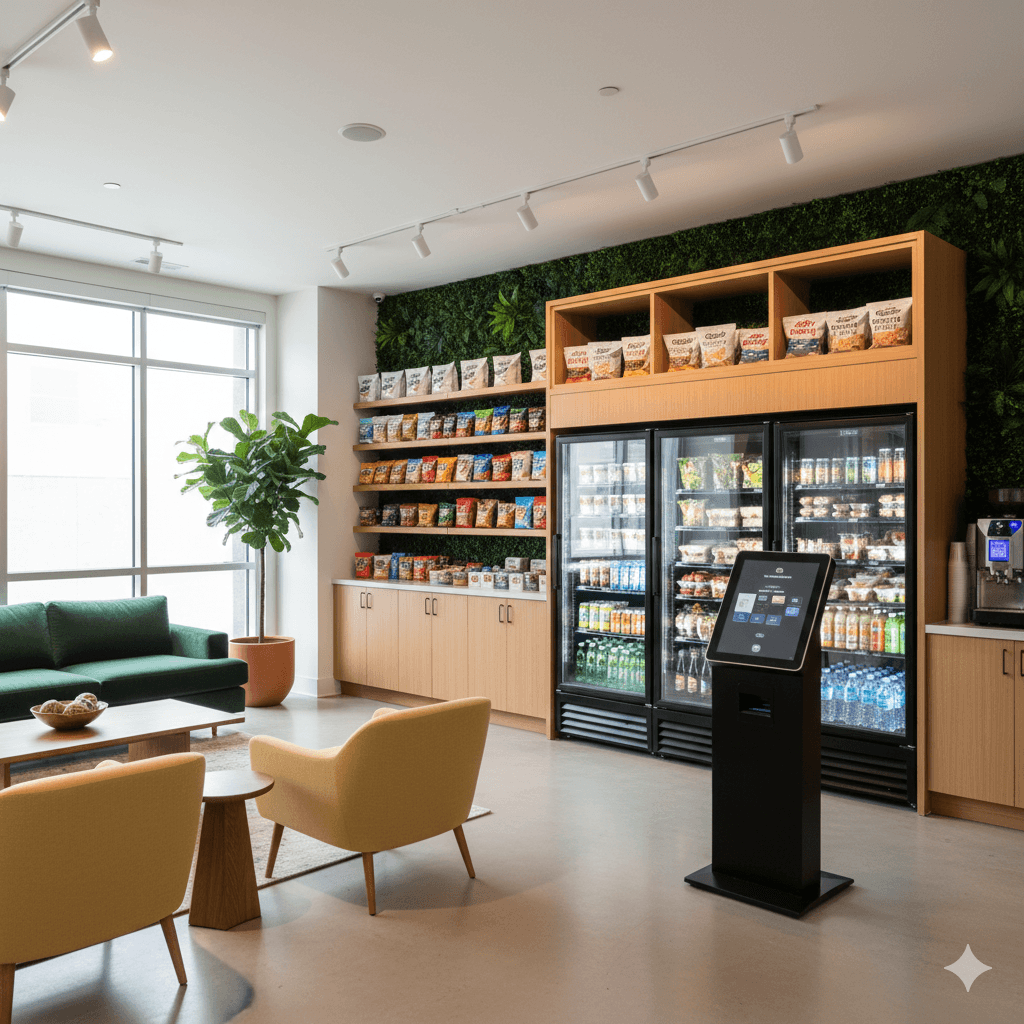
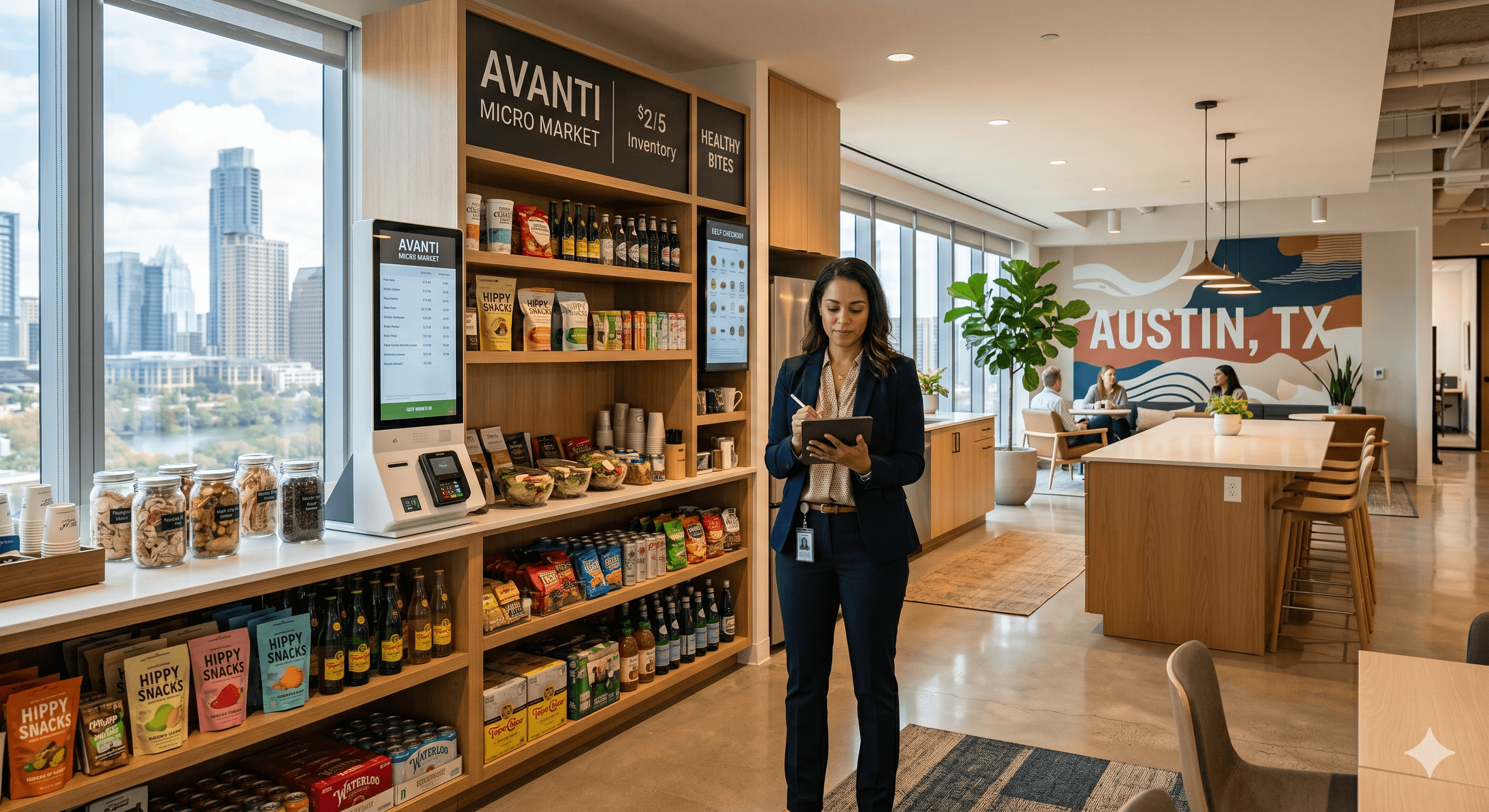
Micro markets are the premium tier. An open-format market with shelving, a refrigerated case, and a self-checkout kiosk transforms a break room or common area into a genuine amenity. They drive higher engagement, support a wider product mix, and tend to perform significantly better on revenue per location than traditional vending — which matters if you're on a revenue-share arrangement.
For Austin apartment communities in particular, a micro market has become a meaningful differentiator in the amenity conversation. Prospective residents notice it. Current residents use it. And it costs the property nothing.
Red Flags to Watch For
Not every Austin vending services provider operates the same way. A few things that should give you pause:
Vague restocking commitments. If a vendor can't tell you specifically how often your location will be serviced and what triggers an additional visit, expect gaps.
No remote monitoring. Any serious operator in 2025 should have telemetry on their equipment — meaning they know what's sold, what's running low, and when a machine has an issue, without waiting for a complaint.
Pressure to sign long-term contracts without performance guarantees. A 3-year placement agreement with no service level commitments is a one-sided deal. Push for performance language or a shorter initial term with a renewal option.
Slow response to machine issues. If a vendor takes more than 24 hours to address a machine down situation during business hours, that's a pattern, not an exception. Ask for references from current Austin properties and specifically ask about service response times.
What to Expect From a Zero-Cost Placement Model
Most reputable Austin vending services operators today offer a zero-cost placement model: the operator provides, installs, maintains, and stocks all equipment at no charge to the property. Revenue is generated through product sales, and in some arrangements, the property receives a commission.
This model works well for properties because it eliminates capital outlay and maintenance responsibility entirely. The operator's incentive is fully aligned with performance — they only make money when the market is well-stocked and well-run.
If a vendor is asking you to purchase equipment, pay a monthly fee, or absorb any maintenance costs, make sure you understand exactly what you're getting in return.
Questions to Ask Before You Sign
Here's a short list to bring into any vendor conversation:
Who owns the equipment, and what happens to it if we end the agreement?
What is your service response time for equipment issues?
How do you monitor inventory remotely?
What does your restocking schedule look like for a property our size?
Can you provide references from current Austin locations?
What are the contract terms, and what does early termination look like?
Do you carry commercial liability insurance, and can we be listed as an additional insured?
The Bottom Line
Choosing an Austin vending services provider is less about finding the fanciest equipment and more about finding an operator with the right service model, local accountability, and contract terms that protect your property.
For most Austin offices, apartment communities, gyms, and medical facilities, the combination of a zero-cost placement model, local operator responsiveness, and a modern format — whether that's a smart cooler or a full micro market — delivers the best outcome.
If you're evaluating options for your Austin property, Nano Market ATX offers free site assessments and custom proposals with no obligation. We're a local, owner-operated business serving Austin properties with fully managed micro markets and smart coolers at zero cost.
Related